
How shell colour actually works
Every eggshell starts white. Calcium carbonate is white; that's the raw material for all of them. What varies is what gets added, and when.
Brown is paint
Brown pigment — protoporphyrin, made from haemoglobin — is applied in the last few hours before laying, as the egg sits in the shell gland. It coats the outside of the shell only.
You can prove this at home. Crack a brown egg and look at the inside of the shell: it's white. Rub a fresh dark Marans egg with a damp cloth and some of the colour lifts off. That's how superficial it is.
Blue is structural
Blue pigment — oocyanin, a bile derivative — is deposited throughout the shell while it forms. A blue egg is blue all the way through, inside and out. It cannot be rubbed off.
This is caused by a single dominant gene, originally introduced by a retrovirus that inserted itself into the chicken genome centuries ago. It's one of the more charming pieces of genetic vandalism in domestic animals.
Which gives you green
Blue shell + brown coating = olive green. That's the entire trick behind Olive Eggers: cross a blue-egg breed with a dark-brown-egg breed and the two mechanisms stack. The darker the brown parent, the deeper the olive.
"Feed changes shell colour." It doesn't. Shell colour is genetic and fixed at hatch. Feed affects shell strength and yolk colour, never shell colour.
"Brown eggs are healthier." Nutritionally identical. Brown eggs cost more because the breeds that lay them are larger and eat more.
"Earlobe colour predicts shell colour." A surprisingly good rule of thumb — white lobes tend toward white eggs — but it fails on plenty of breeds.
One real effect: a hen lays her darkest eggs at the start of a laying cycle. Pigment supply depletes over the season, so a Marans that starts the spring nearly-black will be laying medium brown by late summer. It resets after each moult.
Inside an egg
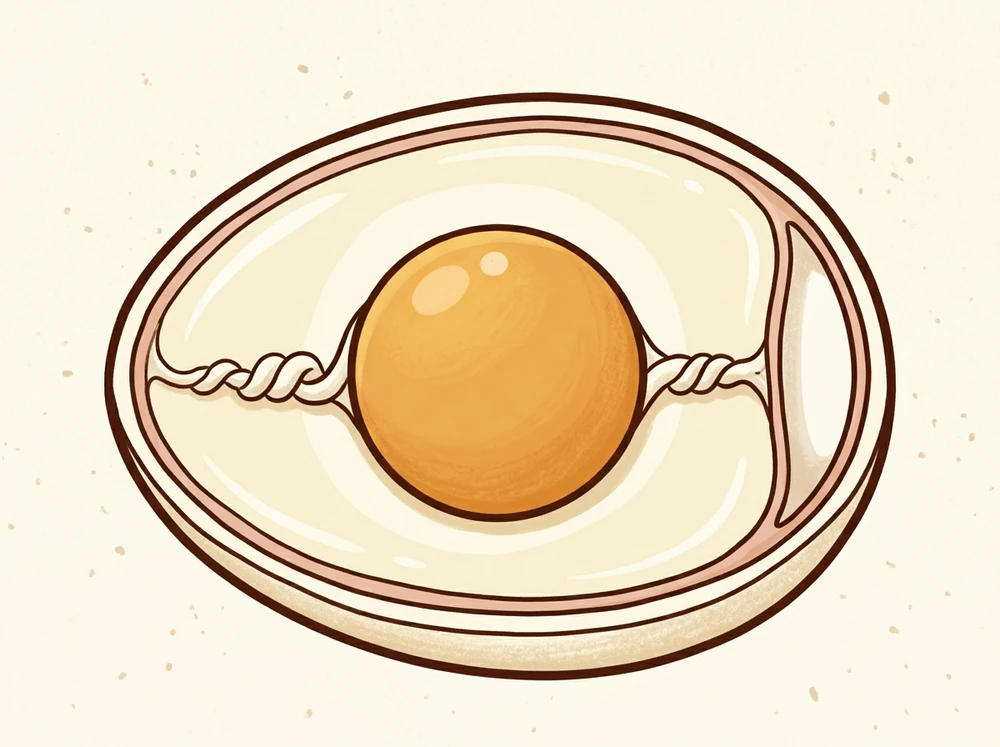
- Shell — about 95% calcium carbonate, with roughly 7,000 microscopic pores. It breathes, which is why eggs pick up fridge smells.
- Membranes — two thin layers just inside the shell, a real barrier against bacteria.
- Air cell — forms at the blunt end as the egg cools after laying, and grows over time as moisture evaporates out through the pores.
- Albumen (white) — mostly water and protein, in a thick inner layer and a thinner outer one. The thick white flattens with age, which is why old eggs spread out in the pan.
- Chalazae — the twisted white ropes anchoring the yolk in the centre. Prominent chalazae mean a very fresh egg. They are not, as commonly believed, a partly formed chick.
- Yolk — the actual food store for an embryo, and where most of the vitamins live.
A hen takes about 24–26 hours to build one, of which around 20 hours is spent on the shell alone. She then starts the next one within an hour. This is why even the best layers can't quite manage an egg a day indefinitely — the cycle drifts later until she skips a day and resets.
Collecting
- Collect at least once a day, twice at peak season. Eggs left in the box get stepped on, dirtied, frozen in winter, cooked in summer, or discovered as food.
- Egg-eating is a learned habit and is close to impossible to break once established. It usually starts with one accidentally broken egg. Prevention: collect often, keep plenty of nest boxes with deep bedding, and never feed raw eggs in the shell.
- Keep nest boxes clean and dark. Hens prefer a private, dim spot; if the boxes are unappealing they'll lay behind the shed instead.
- A fake egg helps. A golf ball or ceramic egg tells new layers where eggs belong.
- In freezing weather, collect more often. A frozen egg expands and cracks the shell, which makes it unsafe to keep.
Washing, and why not to
A hen coats every egg as she lays it with a natural antimicrobial layer called the bloom (or cuticle). It seals those 7,000 pores against bacteria and moisture loss. Washing removes it — and worse, washing in cool water makes the egg contents contract and actively draw water and bacteria in through the pores.
So: leave clean eggs unwashed. Brush or dry-wipe lightly soiled ones. Wash genuinely dirty eggs only immediately before use, in water warmer than the egg.
This is the whole reason for a difference that puzzles people: in the US, eggs are washed and sanitised commercially, which strips the bloom and makes refrigeration mandatory. In the UK and most of Europe, washing is prohibited, the bloom stays intact, and eggs sit on unrefrigerated shop shelves quite safely.
Storing and checking freshness
- Unwashed eggs keep 2–3 weeks at room temperature, and around 3 months refrigerated.
- Point the narrow end down. It keeps the air cell at the top and the yolk centred, which extends life.
- Pick one and stick with it. Moving eggs from fridge to counter causes condensation, which defeats the bloom.
- Label the date. A pencil mark on the shell costs nothing and settles every future argument.
- Freezing: not in the shell. Crack, beat lightly, and freeze in an ice-cube tray.
The float test
Put the egg in a glass of water:
- Lies flat on the bottom — very fresh
- Stands upright on the bottom — older but perfectly good; ideal for hard-boiling, since it peels far more easily
- Floats — the air cell has grown large enough that the egg has lost significant moisture. Discard
It works because the air cell grows steadily as moisture escapes. It measures age, not spoilage — so if in doubt, crack a suspect egg into a separate bowl first. Your nose is the final authority, and a genuinely bad egg leaves no room for debate.
Odd eggs, explained
| What you found | What it means |
|---|---|
| Tiny egg, no yolk "fairy" or "wind" egg | A bit of tissue triggered the shell process without a yolk. Common in new layers and in hens winding down. Harmless. |
| Soft or rubbery shell | Not enough calcium, or the egg was rushed through. Check the oyster shell dish — see grit vs oyster shell. Occasional ones are normal in new layers; persistent ones need attention. |
| Double yolk | Two yolks released too close together. Common in young hens still calibrating, and in some heavy breeds. They very rarely hatch. |
| Wrinkled or "body checked" | The shell cracked in the gland and was repaired. Usually stress — a predator scare, a move, or a very hot day. |
| Blood spot | A tiny ruptured vessel on the yolk's surface. Completely safe; flick it out if it bothers you. Nothing to do with fertilisation. |
| Meat spot | A fleck of tissue from the oviduct. Harmless. |
| Green or iridescent white | Riboflavin. Fine. |
| Green ring around a boiled yolk | Overcooked — iron and sulphur reacting. Cosmetic only. |
| Chalky or speckled shell | Extra calcium deposited unevenly. Normal variation. |
Why backyard yolks are so orange
This one is down to feed. Yolk colour comes from xanthophylls — plant pigments in greens, marigold, maize and, above all, bugs. A hen that free-ranges eats far more of them than a caged bird on formulated feed, and the yolk goes from pale yellow to deep orange.
It's a real signal of a varied diet, and it does correlate with somewhat higher carotenoid content. But it is not proof of a better egg on its own — commercial producers add marigold extract to feed specifically to darken yolks. Colour can be bought.
What backyard eggs genuinely have going for them is freshness. A shop egg is often several weeks old before you buy it. Yours was laid this morning, and the difference in a poached egg is not subtle.
Want the birds that lay each colour? The breed directory is filterable by shell colour. Or go and crack open some gloriously useless chicken facts.